
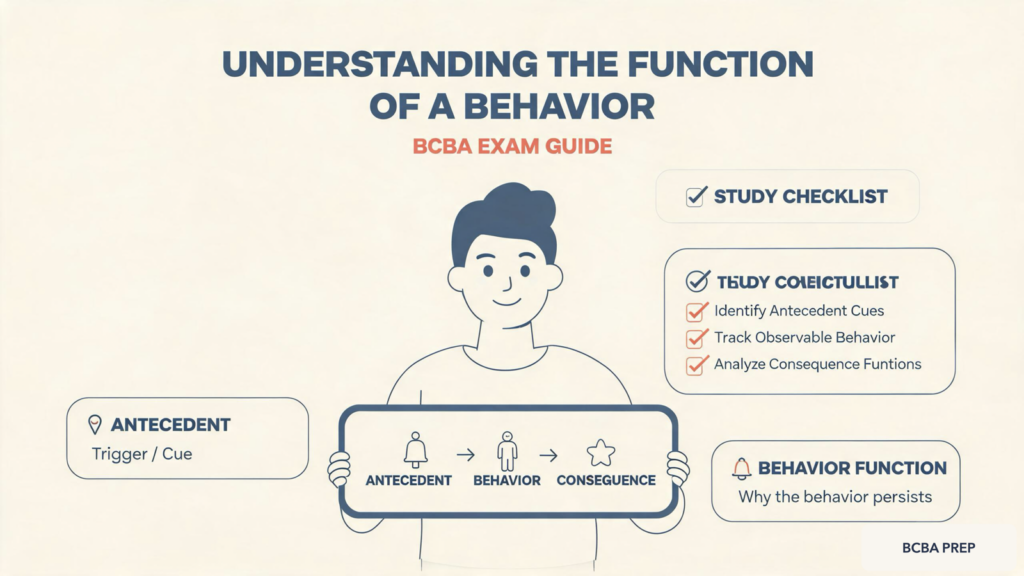
Defining the Function of a Behavior
Understanding the function of a behavior is essential in Applied Behavior Analysis (ABA). Function refers to the maintaining consequence that reinforces a behavior, not its appearance or topography. In ABA, we ask: why does this behavior persist? This question is at the heart of every functional behavior assessment (FBA) and drives effective intervention design. Without identifying the true function, interventions risk being ineffective or even counterproductive, as they may fail to address the reason the behavior continues.
Table of Contents
- Defining the Function of a Behavior
- How to Identify the Function of a Behavior Using ABC Data
- Why the Function of a Behavior Matters on the BCBA Exam
- Quick Reference: Function of a Behavior Checklist
- Summary: Mastering the Function of a Behavior
For example, two children might both engage in hand-flapping. One child flaps to gain teacher attention (social positive reinforcement), while the other flaps because it produces pleasurable sensory input (automatic positive reinforcement). The same topography serves different functions, so interventions must be individualized based on function. This distinction is a cornerstone of ethical, evidence-based ABA practice.
What Does ‘Function’ Mean in ABA?
Function describes the relationship between a behavior and the environment that maintains it. A behavior is strengthened by what happens immediately after. This consequence is the key to identifying function. In behavior analysis, we say that behavior is lawful; it occurs because it works for the individual in that context. Therefore, to change behavior, we must understand what consequence is reinforcing it and then modify that contingency.
The Four Common Functions
Every behavior typically serves one of four functions. Recognizing these is a core BCBA exam skill. These functions are derived from behavioral principles of reinforcement and can be categorized along two dimensions: social vs. automatic, and positive vs. negative reinforcement.
- Social positive reinforcement (attention, access to tangibles)—behavior produces a social stimulus. For instance, a child tantrums and a parent gives a preferred toy to stop the crying. The behavior of tantrum is reinforced by access to the toy.
- Social negative reinforcement (escape, avoidance)—behavior removes or postpones an aversive stimulus. For example, a student refuses to start a worksheet and the teacher allows the student to sit out. The refusal behavior is reinforced by escape from the aversive task.
- Automatic positive reinforcement (sensory stimulation)—behavior produces its own reinforcing consequence. Hand-flapping, rocking, or finger flicking that feels good are examples. The reinforcer is intrinsic to the behavior itself.
- Automatic negative reinforcement (pain attenuation)—behavior reduces an internal aversive stimulation. Scratching an itch, rubbing a sore muscle, or seeking sensory input to block pain are examples. The behavior removes discomfort without involving another person.
Note: Some behaviors may serve multiple functions, but typically one main function maintains the behavior most of the time. Functional analysis (FA) is the gold standard for confirming the function.
How to Identify the Function of a Behavior Using ABC Data
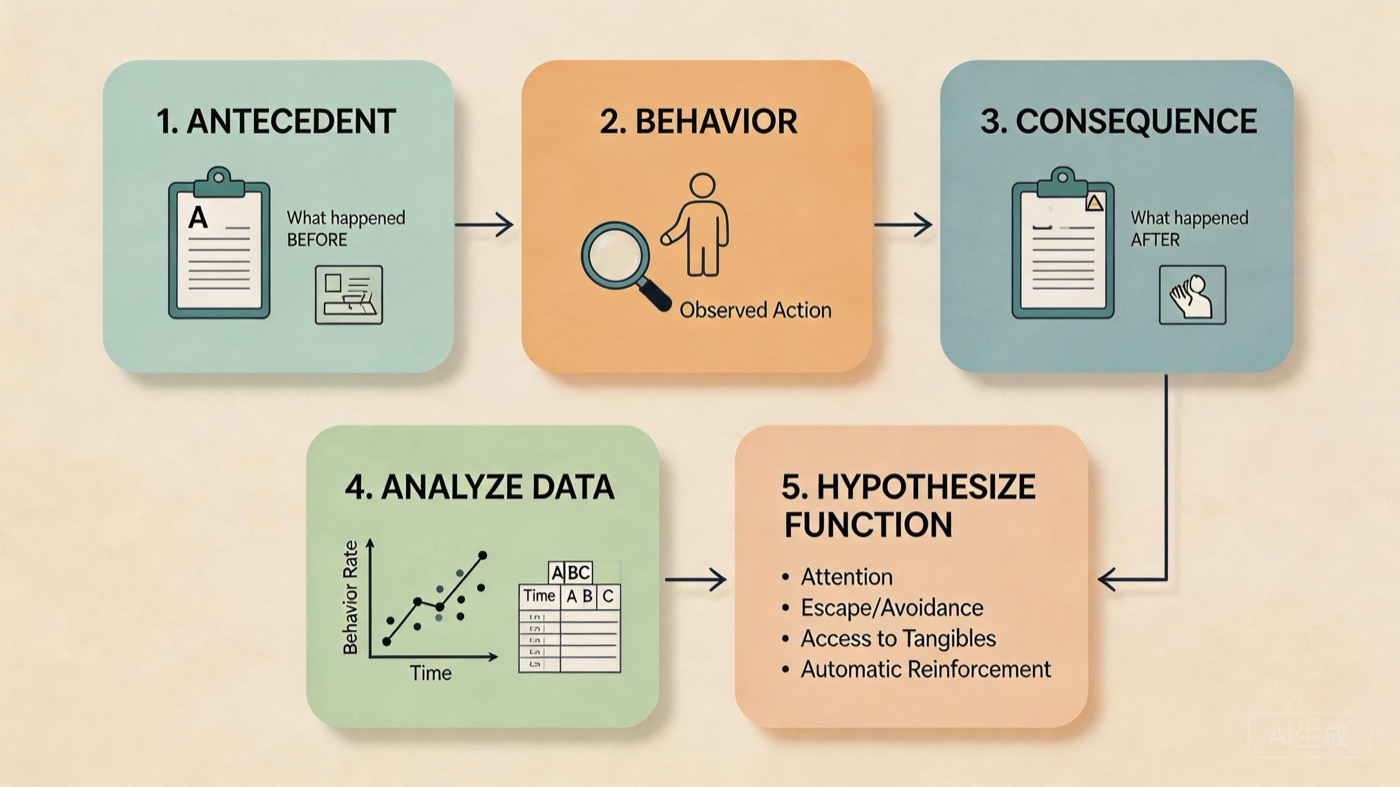
To determine function, collect data on the three-term contingency: Antecedent-Behavior-Consequence (ABC). Focus on the consequence that occurs contingently. ABC data collection is a direct observation method that provides objective records. It is essential to collect multiple instances to identify patterns, as one isolated event may not represent the typical maintaining contingency.
Step-by-Step: ABC Analysis
Follow these steps to hypothesize the function:
- Antecedent: What happened right before the behavior? Describe the environmental conditions, demands, or events that set the occasion for the behavior. For example, “Teacher asked student to complete a math problem.”
- Behavior: What did the person do? (describe objectively). Avoid labels like “aggressive” and instead use specific actions: “Student threw the pencil and said ‘No!’”
- Consequence: What happened immediately after? (identify the maintaining event). This is the most critical component for function. For instance, “Teacher removed the worksheet and told the student to calm down.” The consequence of escape from the task suggests a negative reinforcement function.
Always look for consistency across several ABC sequences. A single data point may be influenced by extraneous variables, but patterns across at least three to five occurrences strengthen your hypothesis.
Worked Example 1: Attention Function
A child screams during quiet play. The parent immediately scolds the child. The consequence is attention. Hypothesis: the function is social positive reinforcement (attention). If the child’s screaming increases when the parent scolds and decreases when the parent ignores (withholding attention), the hypothesis is supported. Note: even negative attention (scolding) can function as a reinforcer for some individuals.
Worked Example 2: Escape Function
A student rips a worksheet during math. The teacher sends the student to the hallway. The consequence is escape from task. Hypothesis: the function is social negative reinforcement (escape). If the student’s ripping behavior occurs more frequently when difficult math problems are presented and less often when easy tasks are given, the escape hypothesis is reinforced.
Worked Example 3: Automatic Reinforcement
A person flicks fingers repeatedly without any social reaction. The behavior produces sensory stimulation. Hypothesis: the function is automatic positive reinforcement (sensory). This is often more challenging to confirm because the reinforcer is not observable externally. Functional analysis conditions may include an “alone” condition to see if the behavior persists in the absence of social consequences. If it does, automatic reinforcement is likely.
Why the Function of a Behavior Matters on the BCBA Exam
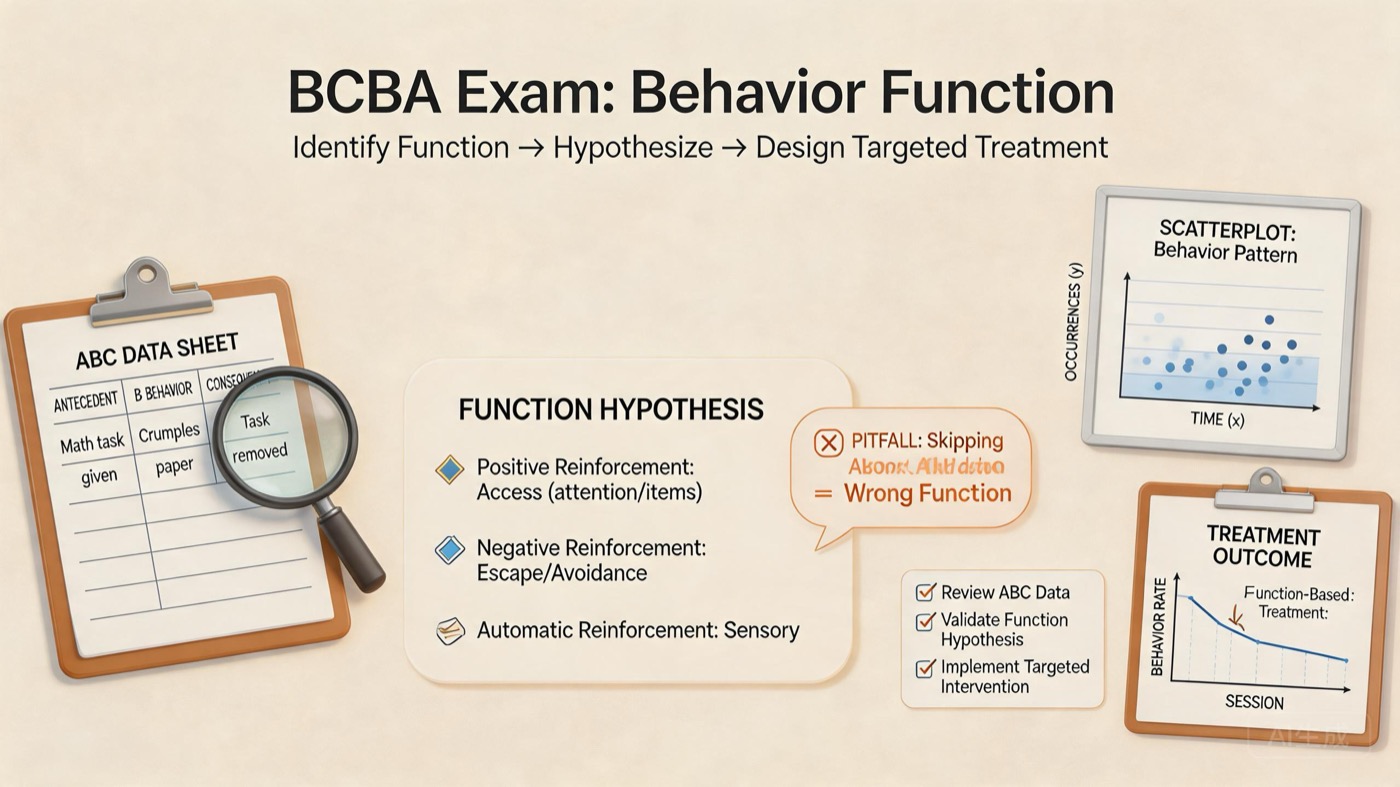
The BCBA exam frequently tests your ability to identify function from vignettes. Knowing function is critical for designing effective, function-based treatments. Exam questions often present a scenario and ask you to: (a) identify the most likely function, (b) select an appropriate replacement behavior, or (c) choose a function-based intervention. Without a solid grasp of the four functions and how to derive them from ABC data, you risk losing valuable points.
Common Exam Traps
Watch for these pitfalls when answering function questions.
- Confusing function with topography. Two identical topographies can have different functions. A single instance of “hitting” may be maintained by attention in one case and by escape in another. Do not assume function based on the look of the behavior.
- Assuming function from behavior alone. Always look at the consequence. The antecedent can provide context, but the consequence is the primary indicator of function. For example, if a student throws a pencil and the teacher gives the student a break, the likely function is escape, not attention, even if throwing looks attention-seeking.
- Misreading indirect assessment data. Interviews and rating scales can be useful, but they are subject to reporter bias. Always validate indirect findings with direct observation (ABC data) and, if possible, functional analysis. The exam may present conflicting data; prioritize direct observation.
- Overlooking automatic reinforcement. When no social consequence is apparent, consider automatic reinforcement. If the behavior occurs in the absence of others or persists even when ignored, automatic reinforcement is a plausible hypothesis.
How Function Guides Intervention
Function-based interventions are more effective than generic punishment. For example, if the function is escape, teach a replacement behavior that requests a break (e.g., saying “break, please”). Then, reinforce the replacement behavior with the same consequence (escape from the task) to ensure it is effective. This is the principle of functional equivalence. For more on this, see our guide on functional behavior assessment.
For instance, if a child hits to gain attention, a replacement behavior might be tapping the adult’s shoulder. The adult should then provide attention immediately for the tap, while withholding attention during hitting. This differential reinforcement of alternative behavior (DRA) is a core ABA strategy.
Exam tip: On questions that ask “Which intervention is most appropriate?”, always match the intervention to the function. If the function is access to tangibles, a token economy might work; if escape, teach a request for a break.
Quick Reference: Function of a Behavior Checklist
Use this checklist when analyzing exam scenarios.
- Identify the consequence immediately after behavior.
- Classify the consequence: social or automatic? positive or negative?
- Confirm with ABC data across multiple occurrences. Look for patterns, not isolated incidents.
- Avoid topography bias; same behavior may serve different functions.
- Consider automatic reinforcement when no social consequence is visible.
- Check if the consequence is delivered contingently (i.e., only after the behavior occurs).
This checklist can be memorized for quick recall during the exam. Consider writing it on scratch paper if allowed.
Summary: Mastering the Function of a Behavior
Mastering the function of a behavior is a must for BCBA exam success. Remember: function is about maintaining consequences, not behavior form. Practice with ABC analysis and always check your assumptions with data. For additional practice, explore our free BCBA mock exam questions. You can also review the official BACB resources at BACB.com.
Ultimately, understanding function empowers you to create ethical, effective interventions that respect the individual’s needs while promoting socially significant behavior change. Keep this guide handy as you study, and you will be well-prepared for exam questions on this foundational topic.


