
What Are Extraneous Variables in ABA?
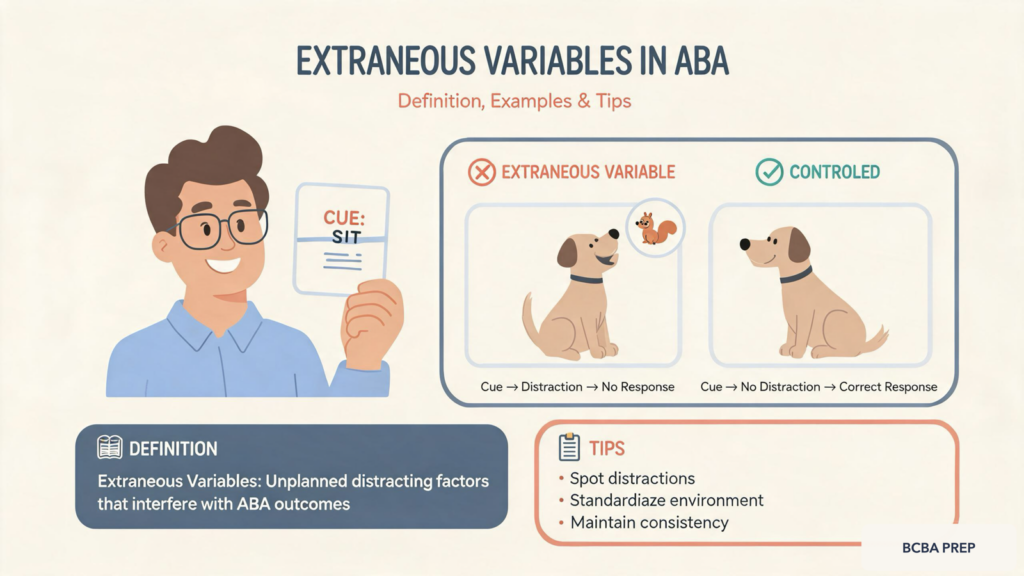
In applied behavior analysis, an extraneous variable is any factor other than the independent variable that could influence the dependent variable. These variables threaten internal validity by providing alternative explanations for behavior change. For BCBA candidates, identifying and controlling extraneous variables is a core competency. On the exam, you’ll be asked to recognize these variables in scenarios and propose ways to minimize their impact on experimental outcomes. Failing to account for extraneous variables can lead to incorrect conclusions about the effectiveness of an intervention, so mastering this concept is critical for both exam success and real-world practice.
Table of Contents
- What Are Extraneous Variables in ABA?
- Types of Extraneous Variables in Single-Subject Research
- ABA Worked Examples: Extraneous Variables in Action
- Exam Relevance: Why BCBA Asks About Extraneous Variables
- Quick Checklist: Control Extraneous Variables on Exam Day
- Final Summary
Extraneous vs. Confounding Variables: Key Distinction
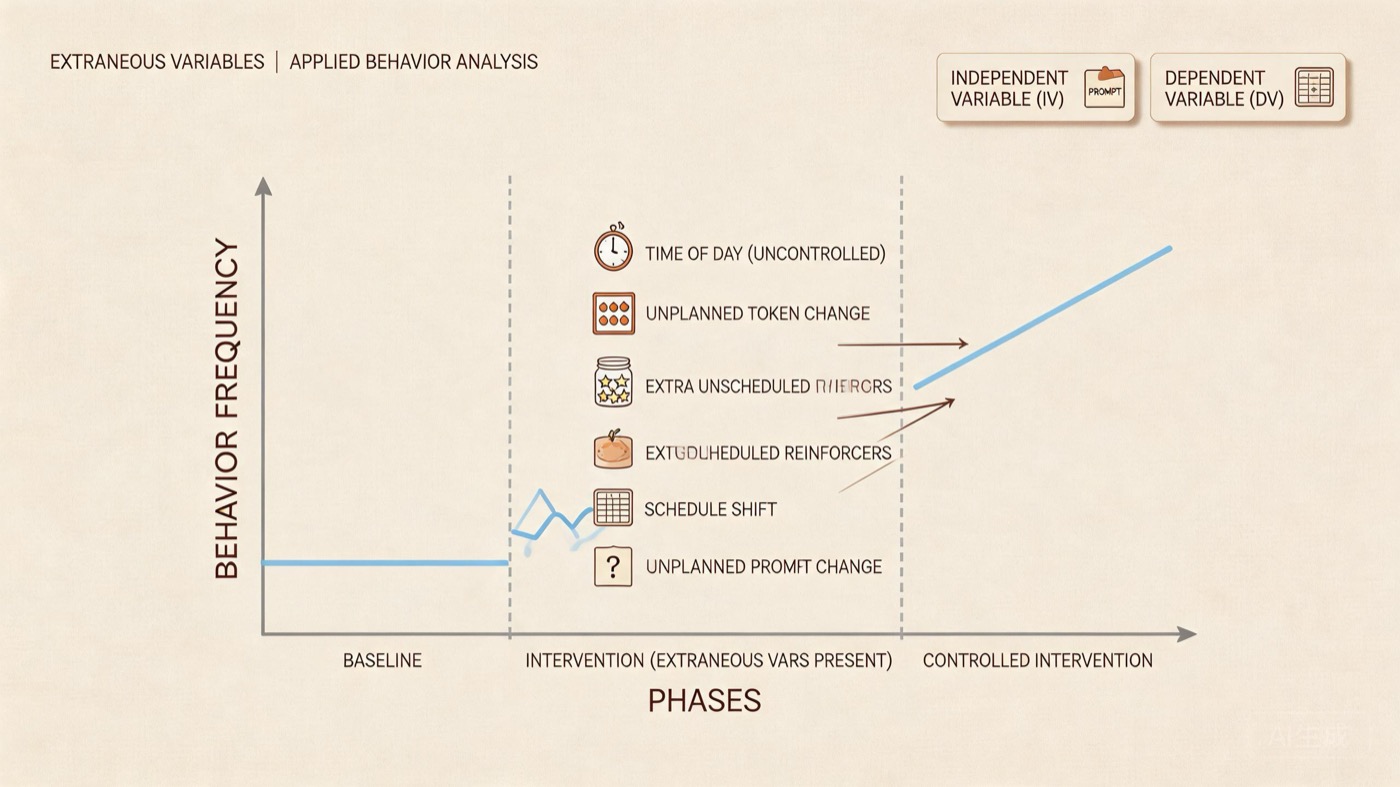
Not all extraneous variables become confounds. An extraneous variable becomes confounding only when it systematically varies with the independent variable. For example, if you implement a DRO procedure only in the afternoon, but baseline sessions were in the morning, time of day is confounded with the intervention. Unsystematic extraneous variables, like a one-time noise, are less threatening but still worth noting. Understanding this distinction is essential because many exam questions will test whether you can differentiate between a mere extraneous variable and one that actually threatens the internal validity of the study. Always ask yourself: Does this variable change in a systematic way that could rival the independent variable’s effect?
Another common pitfall is assuming that any extraneous variable automatically invalidates the study. In reality, if the extraneous variable is randomly distributed across conditions (e.g., occasional loud noises that occur equally in baseline and intervention), its impact may be minimal. However, when the variable is consistently present in one phase but not another, it becomes a serious concern. For example, if data collection always occurs in a noisy classroom during intervention but in a quiet room during baseline, the noise is confounded with the treatment, and you cannot confidently attribute behavior change to the independent variable.
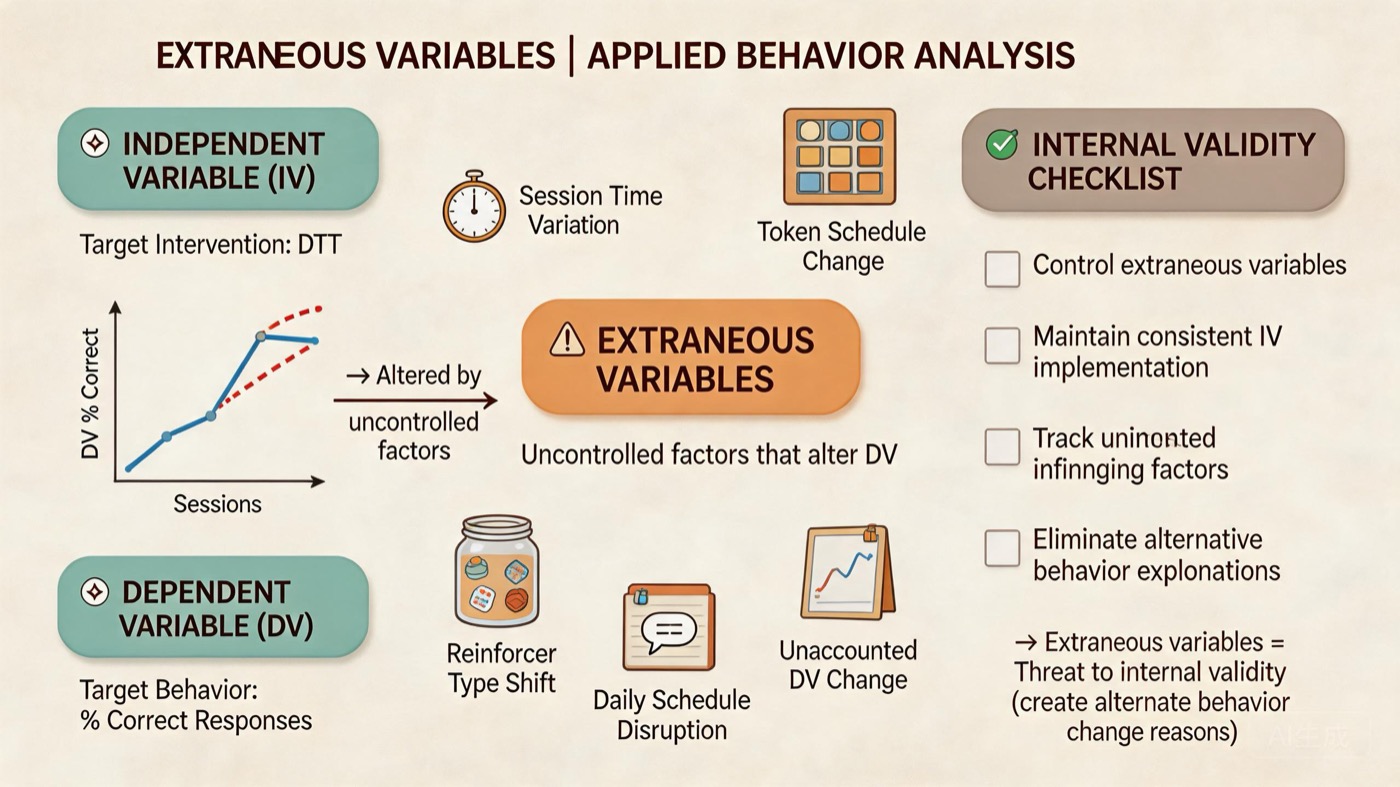
Types of Extraneous Variables in Single-Subject Research
Extraneous variables in ABA fall into three main categories. Recognizing them is the first step to control. Let’s dive deeper into each category with additional examples to solidify your understanding.
Environmental Variables
- Noise level: A loud construction outside during some sessions can affect behavior. For instance, a client may become more distracted or agitated, leading to increased problem behavior that is unrelated to the intervention.
- Lighting or temperature: A dim room may increase off-task behavior because the client struggles to see materials, while a too-warm room might induce drowsiness and reduce responding.
- Time of day: Sessions before lunch vs. after lunch may differ in motivation. A client may be more compliant in the morning when they are well-rested, or more irritable in the afternoon if they are hungry or tired.
Participant Variables
- Fatigue or illness: A client who slept poorly may show more problem behavior. Chronic conditions like allergies or sinus infections can also affect attention and energy levels across sessions.
- Medication changes: New meds can alter response rates. For example, a stimulant medication may increase focus, while a sedative may slow responding. Always track medication changes as potential extraneous variables.
- Motivation shifts: Satiation or deprivation affect reinforcer effectiveness. If a client has just eaten a favorite snack, food-based reinforcers may lose their power, leading to a decrease in target behavior that has nothing to do with the intervention.
Procedural Variables
- Instructor drift: The therapist implementing the intervention inconsistently over time. For instance, a therapist may gradually provide more prompts or less praise as the study progresses, altering the independent variable unintentionally.
- Measurement drift: Observers gradually change how they record data. For example, an observer might become stricter in defining “aggression” over time, leading to inflated or deflated rates.
- Order effects: The sequence of conditions (e.g., always baseline first) may influence results. Practice effects, where a client improves simply because they are accustomed to the routine, can confound the treatment effect.
ABA Worked Examples: Extraneous Variables in Action
Applying the concept to real scenarios helps for the BCBA exam. Below are two examples with ABC analysis and hypothesized function, plus a third example to reinforce the idea.
Example 1: Teacher Attention During DRO
A teacher implements a DRO procedure to reduce hitting. During baseline, the teacher provides frequent attention for appropriate behavior; during intervention, attention is delivered on a fixed schedule. The extraneous variable is the amount of teacher attention across phases. ABC: A = no access to tangible, B = hitting, C = teacher reprimand. Hypothesized function: attention-maintained. The confound makes it unclear if DRO or the attention change reduced hitting. In this case, the teacher should have held attention constant or used a different control procedure to isolate the DRO effect.
Example 2: Time of Day in FCT
A therapist uses functional communication training (FCT) for manding. Sessions are always after lunch when the client is drowsy. ABC: A = no toy, B = whining, C = delayed mand. Hypothesized function: escape from task. The extraneous variable (time of day) reduces internal validity because the client’s drowsiness may suppress behavior independent of the intervention. To control this, the therapist could schedule sessions at different times or use a reversal design to demonstrate the intervention’s effect across varying conditions.
Example 3: Procedural Drift in Token Economy
A clinician implements a token economy for on-task behavior. Over time, the staff member begins giving tokens more leniently for approximations of on-task behavior rather than strict adherence. This procedural drift means the independent variable (token delivery criteria) has changed, potentially affecting the dependent variable. The extraneous variable here is the changing implementation fidelity. To prevent this, regular integrity checks and retraining sessions are necessary. On the exam, if a scenario mentions that staff were not monitored for procedural integrity, consider this a major extraneous variable threat.
Exam Relevance: Why BCBA Asks About Extraneous Variables
The BCBA exam tests your ability to identify threats to internal validity in experimental designs. Extraneous variables appear in questions about measurement, design selection, and data interpretation. Expect items where you must choose the best control strategy or identify why a particular design is weak. The exam often embeds extraneous variables in lengthy scenarios, so practice scanning for the key details that indicate a potential confound.
Common Exam Traps
- Confusing extraneous with confounding: Many candidates mark an extraneous variable as automatically confounding; but only systematic covariation creates a confound. For example, a one-time thunderstorm is extraneous but not confounding if it occurs equally across phases. However, if it only happens during intervention, it becomes a threat.
- Forgetting to evaluate control strategies: When a scenario describes a potential extraneous variable, ask: Is it controlled (e.g., counterbalanced, held constant)? If not, internal validity is compromised. Common control methods include counterbalancing, random assignment, and maintaining constant conditions.
- Overlooking participant variables: Test items often include details about client fatigue or medication; these are extraneous variables that must be considered. For instance, a scenario might mention that the client started a new medication halfway through the study—this is a classic extraneous variable that could serve as a rival hypothesis for behavior change.
How to Answer Scenario Questions
- Step 1: Identify the independent variable (IV) and dependent variable (DV).
- Step 2: List any other factors that could affect the DV (these are extraneous variables).
- Step 3: Determine if those factors systematically vary with the IV (if yes, they are confounding).
- Step 4: Propose a control method (e.g., counterbalancing, constant conditions, or staggered baselines).
For example, if a scenario describes an ABAB design where sessions are held in a quiet room during baseline but in a noisy room during intervention, you would identify room noise as an extraneous variable that is systematically varying with the IV (phases), making it a confound. The control method would be to hold the room constant across all phases.
Quick Checklist: Control Extraneous Variables on Exam Day
Use this checklist when analyzing exam scenarios or designing your own studies. Memorizing these strategies can help you quickly eliminate incorrect answer choices.
- ☐ Hold environmental conditions constant across phases (e.g., same time, location, materials).
- ☐ Check participant state: Note fatigue, illness, or medication changes. If mentioned, consider it a potential extraneous variable.
- ☐ Ensure procedural integrity: Use checklists and interobserver agreement to monitor consistency.
- ☐ Counterbalance conditions if order effects are possible. For example, if you have two treatments, alternate the order across participants or sessions.
- ☐ Use multiple baseline designs to control for history and maturation, as they stagger intervention start times across behaviors or settings.
- ☐ When in doubt, ask: “Does this variable change with the independent variable?” If yes, it’s a threat to internal validity.
Final Summary
Extraneous variables are any uncontrolled factors that can affect the dependent variable in ABA research. They become confounding when they systematically vary with the independent variable. By recognizing types (environmental, participant, procedural) and applying control strategies, you protect internal validity. For the BCBA exam, practice identifying extraneous variables in scenarios and suggesting controls. Remember, the key to mastering this topic is distinguishing between variables that merely exist versus those that actually compromise the ability to draw cause-and-effect conclusions. For more on experimental designs, see our guide on single-subject experimental designs. Also reference the BACB’s official website for ethics and design standards.


